Why mice move into Ozarks homes every fall

Mice move into Ozarks homes in fall because your house is the warmest, driest, best stocked spot inside their very short travel range. That is the whole story. The first run of 40-degree nights in late September does not create mice; it simply ends the outdoor version of their life and pushes the ones already living along your foundation through a gap you have walked past a thousand times.
On this page
Why fall, every year, in every Ozarks neighborhood
Mice come in during fall because they are not travelers, they are opportunists with a very short commute. University of California IPM states that house mice seldom venture more than 30 feet from their nest sites and food supply. Read that again with your yard in mind. The mouse that will be in your pantry at Thanksgiving is, this week, in the ivy, the woodpile or the tall grass along your fence line. Nothing has to migrate. It walks toward the warm air leaking out of your rim joist.
Deer mice do the same out in the more rural Ozarks. The Missouri Department of Conservation says deer mice commonly enter buildings in the fall, where they leave their droppings and become a nuisance, and notes this species mates chiefly in spring and fall. The season that drives them indoors is also a season they breed in.
What one ignored winter actually looks like
An ignored fall mouse problem compounds quietly until spring, and the arithmetic is the alarming part, not the mice. University of Missouri Extension states that a female house mouse may have five to 10 litters of usually five or six young each in a year, with the young reaching maturity in six to 10 weeks. Two mice in October are not two mice in February.
Picture the version nobody wants to picture. It is 2 a.m. in January, the furnace is running, and above your bedroom ceiling something is working: insulation shredded into a nest the size of a grapefruit, a mouse stripping the jacket off a cable run in the dark. University of California IPM notes that mice gnaw electrical wiring and that many fires of unknown origin are believed to be caused by rodents gnawing on wires. Downstairs, the trail continues. UC IPM puts the output at roughly 50 to 75 droppings per mouse per day, which lands in your silverware drawer and along the back of the pantry shelf. You find it in a flashlight sweep some Saturday morning and feel your stomach drop.
None of that is exotic. It is the ordinary result of leaving a quarter-inch gap open from October to March.

House mouse or deer mouse?
The two mice you meet in the Ozarks are the house mouse and the deer mouse, and telling them apart takes one look at the belly. A deer mouse is sharply two-toned: grayish to reddish brown on the back, clean white underneath, with big protruding black eyes and large ears. That is the Missouri Department of Conservation description, and MDC puts most of them under six inches in total length. A house mouse is a uniform dull gray-brown, top to bottom.
It matters because deer mice are the country cousins, tied to fields, fencerows and outbuildings, and MDC advises avoiding contact with wild mice and cleaning contaminated areas with disinfectant. MDC also notes that hantaviruses connected with this species have not been identified in Missouri. Gloves and a spray bottle, then, not panic. Never sweep or vacuum dry droppings. Wet them down first.
Early signs, roughly in the order you notice them
Mice announce themselves in a fairly predictable sequence, and University of Missouri Extension names the core three signs as droppings, fresh gnawing and tracks. Here is how that shows up in real rooms.
| What you notice | Where it turns up | What it tells you |
|---|---|---|
| Droppings, dark and rice-grain sized | Drawers, under the sink, pantry corners, along baseboards | Active feeding route right there |
| Scratching or light scurrying at night | Wall cavities, above a bedroom ceiling, in the range hood duct | Nesting inside the structure, not just visiting |
| Gnawed corners on boxes and bags | Cereal, rice, dog food, birdseed in the garage | Food source found; numbers will climb |
| Greasy smudge marks | Where pipes enter a wall, along a joist edge | An established runway, used nightly |
| Shredded insulation or paper wads | Attic, crawl space, back of a cabinet | A nest, which means litters |
Your weekend plan, and it is a genuinely good one
Most fall mouse problems in the Ozarks are fixable by the homeowner, as long as you seal first and trap second. Trapping without sealing is a revolving door. Here is the sequence worth a Saturday.
- Walk the foundation with a flashlight held flat against the wall. Side light throws shadows into gaps your eyes skip in daylight. Check the gas line, AC line set, dryer vent and cable entries, the garage door corners and the crawl-space door.
- Know the threshold. UC IPM states house mice can squeeze under gaps a quarter inch tall and through openings three eighths of an inch wide. If a pencil fits, a mouse fits.
- Seal with materials they cannot chew. CDC guidance is to fill small holes with steel wool held in place with caulk, and to close larger holes with lath screen or lath metal, cement, hardware cloth or metal sheeting. UC IPM is blunt that plastic screening, rubber, vinyl, insulating foam and wood do not work. Expanding foam alone is mouse food with extra steps.
- Set snap traps correctly. UC IPM advises placing traps close to walls so mice pass over the trigger, spacing them no more than about 10 feet apart where mice are active, and notes pairs set one to two inches apart raise the catch rate. Use more traps than feels reasonable. Six beats one.
- Bait for what they want. UC IPM says the best bait is often the food they are already eating, peanut butter being the standby, and that nesting material such as cotton wool or dental floss works well in fall.
- Cut the outdoor buffet. Birdseed and pet food into lidded metal cans, firewood off the ground and away from the siding, ivy pulled back off the foundation. Mice under the woodpile are also what bring copperheads to the back steps, as our guide to copperheads around an Ozarks home explains.
Do this in early October and you are usually done inside ten days. Our Springfield pest control cost guide covers what the paid version runs.
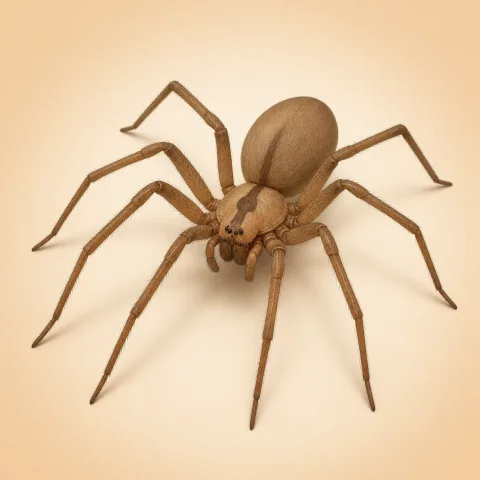
One bonus worth naming: the clutter you haul out of the garage while mouse-proofing is exactly the habitat brown recluse spiders want, which is why our guide to where brown recluse hide in the house reads like a mouse checklist with different legs.
When DIY is not enough
A fall mouse problem is past DIY when the building itself is the problem. Any one of these signs is your cue.
- You are still catching mice after two weeks of correct trapping. A steady catch rate means an open entry you have not found, usually up high or deep in the crawl space.
- The noise is above the ceiling, not behind a baseboard. Attic and soffit activity means they are climbing the exterior and entering at the roof line. That is ladder work over insulation.
- You find nests or heavy droppings in crawl space or attic insulation. That is an established population plus a contamination cleanup, and the insulation often has to be replaced.
- The entry points are structural. A settled foundation crack, gaps behind brick veneer or a crawl door that no longer meets its frame will not be fixed with a tube of caulk.
- You are seeing mice in daylight. Mice prefer the dark, so daytime sightings usually mean the population has outgrown the quiet hours.
The call that ends it
If two or more of those signs describe your house, the sensible next step is a phone call, not another trip to the hardware store. Call (855) 629-1061, say what you are hearing and where in the Ozarks you are, and you get a price and a scheduling window on the call. Ozarks Pest Pros is a free referral service that connects you with a licensed local provider covering your ZIP code, and you can book or not, with no obligation either way. A professional rodent control visit in Springfield is mostly an exclusion job: someone who does this every October finds in an hour the entry you would spend a month chasing. Same-day and 24/7 emergency services are subject to provider participation, location, technician availability, and demand. Availability is not guaranteed and may vary by market and appointment capacity.
So you are not calling blind: rodent work in the Springfield area commonly runs about $150 to $400 for a one-time service with follow-ups, and quarterly plans covering mice plus the usual Springfield pest services run about $40 to $70 per visit. Those are typical market ranges, not a quote.
Here is the reassuring part, and it is true. Mice are a seasonal, solvable problem with a deadline attached. Seal the house before the first hard cold snap and the fall wave goes somewhere else, because a mouse that cannot get in does not stand there and argue about it. Handle it properly once and you tend not to think about it for years. Do the flashlight walk this weekend.
Ozarks fall mouse FAQ
Why do mice come into Ozarks houses in the fall?
Mice come inside in fall because a heated Ozarks house is the warmest, driest, best fed place within their short travel range. University of California IPM notes that house mice seldom venture more than 30 feet from their nest and food supply, so a mouse living along your foundation in September is already close enough. The Missouri Department of Conservation states that deer mice commonly enter buildings in fall, where they leave droppings and become a nuisance.
How small a gap can a mouse get through?
A house mouse can pass through a surprisingly small opening. University of California IPM states that house mice can squeeze under gaps a quarter inch tall and through openings three eighths of an inch wide, which is about the gap at a worn garage door corner or an unsealed pipe penetration. University of Nebraska Extension gives the same practical threshold, openings slightly larger than a quarter inch.
How fast do mice multiply in a house?
Fast enough that timing matters. University of Missouri Extension states that a female house mouse may have five to 10 litters of usually five or six young each in a single year, and that the young reach reproductive maturity in six to 10 weeks. That is why two mice heard in October are a different job from the same noise ignored until February.
Are mouse droppings in a Springfield house dangerous to clean up?
Treat them with normal caution rather than alarm. University of Missouri Extension lists salmonellosis among the diseases house mice can transmit, and the Missouri Department of Conservation advises avoiding contact with wild mice and cleaning contaminated areas with disinfectant. The practical rule is to skip the broom and the vacuum on dry droppings, ventilate the room, wet the droppings with a disinfectant solution, wipe them up with paper towels and wash your hands afterward.