Ant control in Springfield, Missouri
Ants in Springfield homes are usually one of two species, and they call for opposite responses: the odorous house ant is a nuisance that baiting solves, while the carpenter ant nests in moist wood and can damage the structure. This page explains how to tell them apart, how carpenter ant damage differs from termites, why colony baiting beats spraying the trail, and how to get a free price on the call from a licensed Springfield-area provider.
On this page
Which ants invade Springfield homes?
The odorous house ant is the ant behind most Springfield kitchen and bathroom trails: small, dark brown to black, about an eighth of an inch, and named for the rotten-coconut smell it releases when crushed. Colonies live under mulch, pavers and slabs, hold multiple queens, and send workers indoors along scent trails whenever sweets or moisture are on offer. Spring rains and summer drought both push them inside, which is why Springfield trails often appear right after a wet week or in the driest stretch of July.
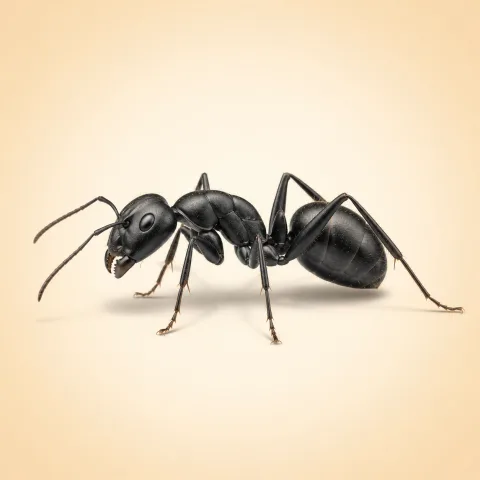
The carpenter ant is the other regular, and it is a different class of problem. Carpenter ants are the large ants, workers up to half an inch, usually black, most active at night. Seeing a few big ants indoors in spring can mean they are foraging from a nest outside; seeing them steadily, or finding piles of fine sawdust-like shavings, suggests a nest somewhere in the structure itself.
Carpenter ants damage wood in humid Ozarks homes
Carpenter ants damage wood by excavating it, and the humid Ozarks climate keeps Springfield homes supplied with exactly the moist, softened wood they prefer. They do not eat wood the way termites do; they carve smooth galleries in it to house the colony, pushing the shavings out through slit-like openings. Nests turn up where moisture has already compromised the wood: around leaky window frames and door sills, under poorly ventilated bathroom floors, in deck posts and porch columns, and in crawl-space joists near plumbing. That moisture link is useful, because a carpenter ant nest is often the symptom that finally reveals a slow leak. Fixing the moisture source is part of any lasting treatment, otherwise the same wood invites the next colony.
Carpenter ant or termite? Check before you panic
Carpenter ants and termites both produce winged swarmers in a Springfield spring, and telling them apart matters because the treatments and the stakes differ. Ants have a pinched waist, bent antennae and front wings longer than the back pair; termite swarmers have a thick waist, straight antennae and four equal-length wings. The debris differs too: carpenter ants push out clean, dry shavings that look like fine sawdust, while subterranean termites work inside mud and leave mud tubes on the foundation. Termites are generally the more destructive insect because they consume sound wood; carpenter ants excavate more slowly and follow moisture. If you find winged insects and are not sure which they are, save a few in a bag, an inspector can identify them in seconds.
Why baiting the colony beats spraying the trail
Effective ant control in Springfield targets the colony, and that is why baiting outperforms spraying. A repellent spray kills the handful of workers on the counter and leaves the thousands below the slab untouched; worse, with odorous house ants a repellent can trigger the colony to split into several new colonies, multiplying the problem. Baiting works with the ants' own biology instead. The provider places a slow-acting bait matched to what the colony is feeding on that season; foragers carry it home and share it through the colony, reaching workers, brood and the queens. The trail typically gets busier for a day or two as ants recruit to the bait, then collapses. For carpenter ants, the provider also traces the nest itself, treats the galleries directly where accessible, and flags the moisture problem that let the nest start. Exterior perimeter work with non-repellent products keeps new colonies from re-establishing along the foundation.
Resist the urge to wipe out the trail. Once bait is placed, the ants walking to it are doing the work for you. Cleaning the trail or spraying the foragers cuts the line between the bait and the colony and can set the treatment back by days.
What ant control costs in Springfield
Ant control in Springfield is usually priced as a one-time service or as part of a quarterly plan, with carpenter ant work scoped after the nest is located. As a general Springfield-area guide, a one-time ant service commonly runs from about $150 to $400, and quarterly plans usually run from about $40 to $70 per visit.
| Service | Typical Springfield range | Notes |
|---|---|---|
| One-time ant service | $150 to $400 | Baiting, perimeter treatment, follow-up |
| Quarterly pest plan | $40 to $70 / visit | Ongoing ant and general pest coverage |
| Carpenter ant nest treatment | Quoted after inspection | Depends on nest location and access |
These are typical market ranges, not a quote. Your price is set by the local provider after an inspection.
How to get a Springfield ant quote
Call the number on this page, describe the ants you are seeing, small and trailing or large and black, and where in the Ozarks you are, and you get a price and a scheduling window on the call. Ozarks Pest Pros is a free referral service that connects you with a licensed local provider covering your ZIP code; you can book with them or not, with no obligation either way. If large ants or sawdust piles are involved, mention it, since carpenter ant work is scoped differently, and while the provider is on site they can also look at anything else you have noticed, such as the brown recluse spiders found in most Springfield basements and garages.
Same-day and 24/7 emergency services are subject to provider participation, location, technician availability, and demand. Availability is not guaranteed and may vary by market and appointment capacity.
Springfield ant FAQ
What kind of ants are common in Springfield, MO?
The odorous house ant is the small dark ant behind most Springfield kitchen and bathroom trails, named for the rotten-coconut smell it gives off when crushed. The carpenter ant is the large black ant, up to half an inch, that nests in moist wood and is the species that can damage a home's structure over time.
How much does ant control cost in Springfield?
A one-time ant service in the Springfield area typically runs from about $150 to $400, and quarterly plans usually run from about $40 to $70 per visit. These are typical market ranges, not a quote; the price you receive is set by the local provider after an inspection, and locating carpenter ant nests can add to the scope.
Do carpenter ants damage homes like termites?
Carpenter ants damage wood, but differently from termites. They do not eat wood; they excavate smooth galleries in it for nesting, usually in wood already softened by moisture, so the damage grows more slowly and points to a leak or damp area. Termites actually consume wood and can spread through sound framing, which generally makes them the more destructive of the two.
Why do ants keep coming back after I spray?
Spraying a trail kills the few workers you can see and leaves the colony untouched, and with odorous house ants a repellent spray can even cause the colony to split into several new ones. The colony simply reroutes and the trail reappears days later. Baiting works instead because foragers carry a slow-acting material back and feed it to nestmates and the queens, which removes the source.
How do I tell carpenter ants from termites?
Look at the waist, antennae and wings. Carpenter ants have a pinched waist, bent antennae and front wings longer than the back pair, while termites have a thick waist, straight antennae and four wings of equal length. Carpenter ants also leave piles of clean, sawdust-like shavings at nest openings, whereas subterranean termites leave mud tubes and soil in their tunnels.